

 English
 русский
 Français
 Español
 Deutsch


Door finishing decisions directly affect installation speed, labor cost, and final appearance. Many builders compare primed and factory-coated options to reduce project timelines without compromising quality. Products such as White Primed Shaker Door and Sliding Shaker Door are widely used in residential projects because they sit between customization freedom and installation convenience, especially in modern interior systems like those seen in streamlined cabinet-style or minimal frame designs similar to industry standards referenced by manufacturers like gywooden.com.
Our company focuses on interior wood door manufacturing and has observed that time efficiency is often the primary factor driving purchase decisions. Understanding how each finish affects workflow helps contractors and distributors plan projects more effectively.
• Core difference between primed and prefinished doors
- Primed doors
- Factory-coated with a base primer layer
- Requires sanding light touch-up and topcoat painting
- Designed for customization flexibility
- Prefinished doors
- Fully painted, stained, or lacquered in the factory
- Ready to install immediately after unpacking
- No additional finishing labor required
The time difference comes mainly from post-delivery labor. Primed systems still require painting cycles, while prefinished systems eliminate onsite coating steps.
• Time-saving comparison from production to installation
1. Primed door workflow time impact
- Surface inspection and dust removal: 10–20 min per door
- Topcoat painting: 20–40 min per layer
- Drying time: 2–6 hours per coat
- Second coat requirement: often needed for durability
Total project time increases significantly when multiple doors are installed, especially in large housing developments.
2. Prefinished door workflow advantage
- Unpack and inspection: 5–10 min
- Hardware installation only
- Immediate hanging and alignment
Factory finishing reduces site work and improves installation speed, often saving several hours per unit compared to primed alternatives
• Where White Primed Shaker Door fits in efficiency planning
A White Primed Shaker Door is often chosen in renovation projects where color matching is important but full customization is still required.
- Allows flexibility in wall color coordination
- Commonly used for rental housing and renovation markets
- MDF or solid-core structure improves paint adhesion consistency
- Requires final coating, which adds labor time but reduces design limitations
Our company produces shaker-style doors with controlled primer thickness (typically 60–90 microns) to ensure smooth topcoat absorption and reduced paint defects.
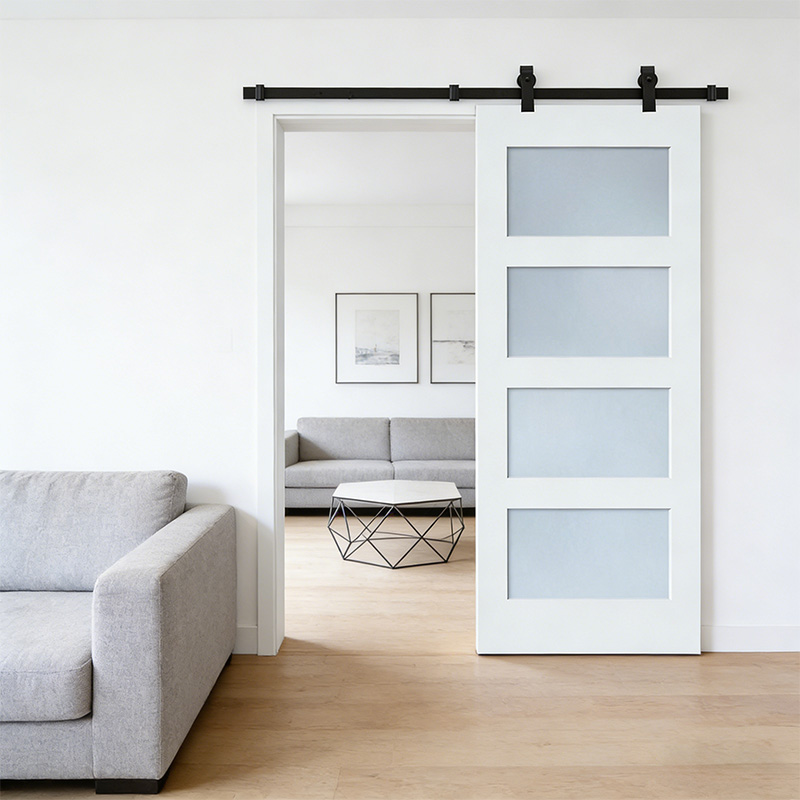
• Sliding Shaker Door and installation speed factors
A Sliding Shaker Door introduces additional hardware considerations that influence total installation time:
- Rail system alignment accuracy: ±2 mm tolerance recommended
- Wall-mounted or ceiling-mounted track systems
- Pre-drilled factory kits reduce installation errors
- Prefinished sliding systems often cut total installation time by up to 30–40% compared with primed versions
Prefinished sliding systems are especially effective in modern apartments where labor time is restricted and rapid turnover is required.
• Technical aspects influencing time efficiency
- Moisture content control
- Factory-controlled wood moisture: 8%–12%
- Reduces post-installation warping delays
- Coating thickness stability
- Prefinished lacquer layers: 120–180 microns
- Primed base layers: 40–80 microns
- Surface smoothness
- Prefinished sanding grade: P180–P240 equivalent
- Improves immediate installation quality
These technical parameters reduce onsite correction work, directly influencing project scheduling efficiency.
• Labor cost and project scale impact
- Small projects (1–5 doors)
- Primed doors may still be cost-effective
- Painting labor manageable
- Medium projects (10–30 doors)
- Prefinished doors reduce coordination time significantly
- Large projects (50+ doors)
- Prefinished systems reduce labor dependency and scheduling delays
Contractors often shift toward prefinished systems when labor cost exceeds finishing material savings.
• Durability vs time trade-off
- Primed + painted onsite:
- High customization
- Quality depends on painter's skill level
- More time required
- Prefinished factory coating:
- Consistent finish quality
- Better scratch resistance due to the controlled curing process
- Minimal maintenance after installation
We typically recommend prefinished solutions for high-traffic environments where long-term stability and time savings both matter.
• Production perspective from our company
Our company's manufacturing process integrates:
- Automated sanding lines for consistent surface preparation
- UV curing systems for faster coating stabilization
- Multi-layer lacquer application for durability
- Quality inspection ensuring color consistency across batches
This reduces onsite finishing requirements and supports faster installation cycles for distributors and contractors.